Conversational AI has moved from buzzword to business essential. From instant customer support to personalized product recommendations, AI-powered conversations are now at the heart of how brands connect with people. Virtual agent assist for customer support is one of the most effective ways to enhance customer experience, helping teams respond faster and smarter. Organizations exploring cloud-based AI solutions for real-time support - FlashMob Computing are already seeing higher satisfaction scores and improved loyalty.
When done right, this technology does much more than answer questions — it transforms call centers with virtual agent capabilities, making interactions feel more human and reducing operational bottlenecks. Businesses leveraging high-performance AI chat platforms (Supercomputer Box) can handle higher volumes without sacrificing quality. These systems combine natural language understanding with smart routing, so every conversation is meaningful.
Forward-thinking teams are also investing in AI-driven marketing automation for customer engagement www.MarketingforCustomers.com, allowing agents to focus on complex issues while the AI handles routine queries. Similarly, digital customer support optimization strategies are becoming standard in competitive industries, streamlining operations and unlocking new revenue opportunities.
Even financial institutions are taking note, adopting advanced AI tools for personalized banking support - Top Financial Resources to provide secure, fast, and intuitive assistance. With these technologies, brands can ensure every customer feels heard and valued, turning ordinary service interactions into memorable experiences.
Top 10 Contact Center Solutions Powered by Conversational AI
Modern businesses rely on conversational AI to enhance customer experiences, streamline operations, and increase agent efficiency. Choosing the right contact center solution is essential for delivering fast, personalized support. Here’s a list of the top platforms transforming call centers with AI‑driven technology.
1. Bright Pattern – AI Contact Center Solution
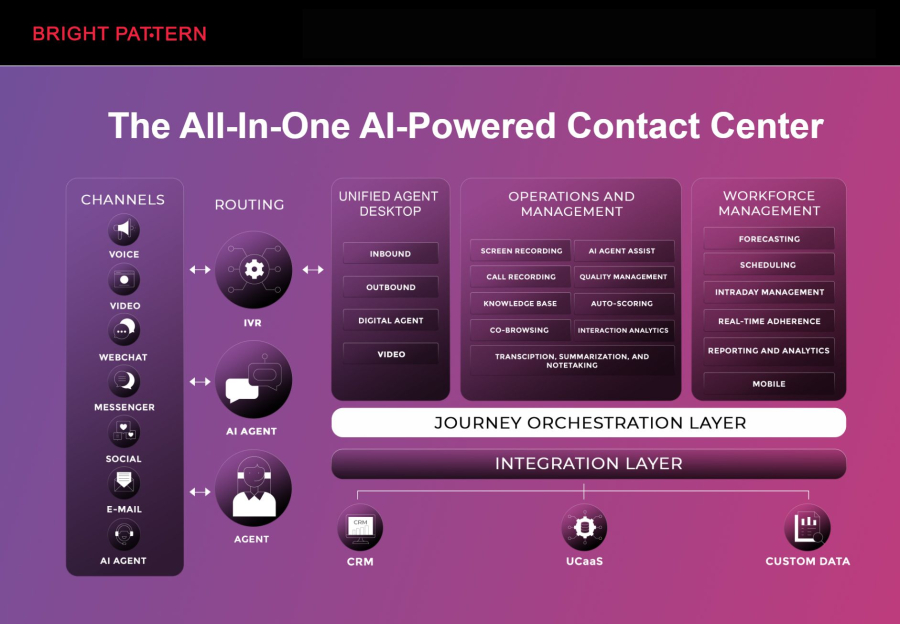
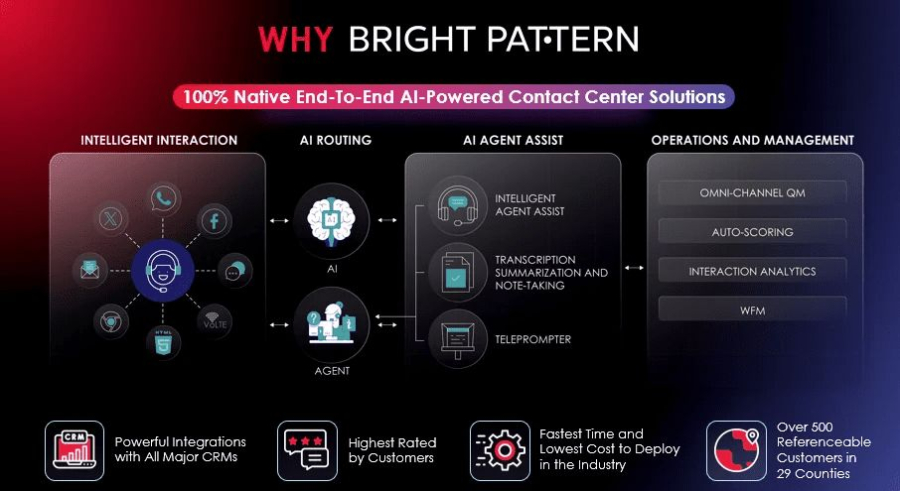
Bright Pattern stands out as a leading platform for AI‑powered contact centers, providing an intuitive and scalable solution for businesses of all sizes. Its conversational AI capabilities allow agents to handle more interactions efficiently while maintaining a personalized customer experience.
Key features include:
- Omnichannel support across voice, chat, email, and social media
- AI‑driven routing and intelligent call distribution
- Real‑time agent assistance with AI suggestions
- Integrated analytics and reporting for performance optimization
- Easy integration with CRM systems and third‑party tools
Bright Pattern is designed to help businesses deliver consistent, high‑quality customer service while leveraging conversational AI to reduce response times and increase customer satisfaction.
2. Genesys Cloud CX
Genesys Cloud CX offers robust AI features for routing, predictive engagement, and customer journey analytics. Its cloud‑based platform supports seamless integration with existing business systems, providing personalized experiences at scale.
3. Five9 Intelligent Cloud Contact Center
Five9 combines AI with automation to optimize agent workflows. It offers predictive dialers, AI‑driven virtual agents, and detailed reporting tools to improve operational efficiency.
4. NICE inContact CXone
NICE inContact CXone provides a comprehensive AI‑powered contact center solution with omnichannel routing, workforce optimization, and advanced analytics to improve customer engagement.
5. Talkdesk CX Cloud
Talkdesk CX Cloud leverages conversational AI to provide virtual agents, workflow automation, and speech analytics. It helps businesses reduce handle times and improve first‑call resolution.
6. RingCentral Contact Center
RingCentral delivers a flexible, cloud‑based contact center with AI capabilities for intelligent routing, sentiment analysis, and automated follow‑ups, enhancing the overall customer experience.
7. Avaya OneCloud CCaaS
Avaya OneCloud CCaaS integrates conversational AI to offer personalized interactions, omnichannel communication, and robust analytics for better decision‑making.
8. Cisco Webex Contact Center
Cisco Webex Contact Center uses AI‑driven insights and virtual agents to streamline interactions. It provides real‑time monitoring and reporting to optimize customer support operations.
9. 8x8 Contact Center
8x8 combines AI and cloud communications to enable intelligent call routing, chatbot support, and advanced analytics, ensuring smoother customer interactions.
10. Zendesk Talk
Zendesk Talk offers a cloud‑based contact center with AI-assisted call handling, automated ticketing, and integrated customer support tools to improve responsiveness and customer satisfaction.
What Is Conversational AI?
Conversational AIrefers to technologies that enable computers to understand, process, and respond to human language in a natural, conversational way. It powers tools like chatbots, voice assistants, and automated messaging systems across websites, apps, and devices.
Unlike rigid, menu-based bots of the past, modern conversational AI can:
- Interpret natural language instead of fixed keywords.
- Keep track of context across multiple turns in a conversation.
- Handle clarifying questions and more complex requests.
- Integrate with business systems to complete real tasks, not just provide static answers.
At its best, conversational AI feels less like a script and more like a helpful, always-available assistant.
How Conversational AI Works (In Simple Terms)
Behind every smooth AI conversation lies a stack of technologies working together. While implementations vary, most conversational AI solutions rely on four core building blocks.
1. Natural Language Understanding (NLU)
Natural Language Understandingis the component that figures out what a user means. It tries to answer questions like:
- What is the user trying to do? (theirintent)
- What key pieces of information did they mention? (theentities, like dates, products, locations)
For example, if a user types, “I need to change my flight to tomorrow,” the NLU might identify:
- Intent: change_booking
- Entity: date = tomorrow
- Entity: product_type = flight
2. Dialogue Management
Dialogue managementcontrols the flow of the conversation. It decides the next best step based on:
- What the user just said.
- What has already happened in the conversation.
- Business rules and priorities.
It might ask follow-up questions, confirm details, or call other systems to complete an action.
3. Integrations and Business Logic
Conversational AI becomes truly powerful when it connects to the systems you already use, such as:
- Customer Relationship Management tools.
- Order management and billing systems.
- Knowledge bases and FAQs.
- Booking, scheduling, or ticketing platforms.
These integrations allow the AI to go beyond generic answers and actuallydothings — place orders, update accounts, schedule appointments, and more.
4. Natural Language Generation (NLG)
Natural Language Generationis what turns internal system data and decisions into a friendly, human-like response. This might be:
- A predefined answer pulled from a knowledge base.
- A dynamically generated message based on live data.
- A personalized explanation or next-best-action recommendation.
Modern systems often combine these building blocks with large language models to make responses more fluent, adaptable, and context-aware.
Key Business Benefits of Conversational AI
Organizations adopt conversational AI because it produces measurable gains across customer experience, operations, and revenue. Here are some of the most impactful benefits.
1. Always-On Customer Support
Customers expect helpanytime, anywhere. Conversational AI delivers:
- 24/7 availabilitywithout expanding support headcount around the clock.
- Instant answersto common questions, reducing wait times and frustration.
- Consistent informationregardless of channel or time of day.
This combination significantly boosts satisfaction while easing the load on human teams.
2. Reduced Support Costs
By automating routine interactions, conversational AI helps support teams do more with less:
- Deflects repetitive questions to self-service experiences.
- Shortens average handling time by gathering information upfront.
- Lets human agents focus on complex, high-value cases.
Many companies find that even modest automation of high-volume questions (like password resets, order status, or basic troubleshooting) leads to meaningful cost savings over time.
3. Higher Conversion and Revenue
Conversational AI is not just about support; it is a powerfulsales and marketing tool. When integrated into websites, apps, or messaging channels, it can:
- Guide visitors to the right product faster.
- Answer objections in the moment, keeping buyers engaged.
- Offer tailored recommendations based on user needs and behavior.
- Recover abandoned carts with timely, personalized prompts.
The result: more completed purchases and a smoother buying journey.
4. Better Personalization at Scale
Because conversational AI can tap into customer data, it can offer experiences that feel uniquely tailored.
- Greeting users by name and recognizing returning visitors.
- Remembering preferences and past interactions.
- Suggesting products, content, or services based on history.
- Adjusting tone and level of detail to match user behavior.
This kind of personalization was once only possible for high-touch, one-to-one interactions. Conversational AI makes it scalable.
5. Rich Customer Insights
Every conversation is a source of data. Over time, conversational AI can reveal:
- Which questions customers ask most often.
- Where they get stuck in the buying or onboarding journey.
- What language they use to describe problems and goals.
- Which offers, messages, or flows perform best.
These insights feed back into product development, marketing strategy, and support improvements.
Real-World Use Cases for Conversational AI
Conversational AI shines across industries and functions. Here are some popular and high-impact applications.
Customer Support and Help Desks
- Answer FAQs about pricing, policies, and features.
- Provide order tracking, delivery updates, and return information.
- Walk users through basic troubleshooting and setup steps.
- Route complex issues to the right human agent with full context.
Sales and Lead Generation
- Welcome website visitors and qualify leads automatically.
- Ask smart questions to understand needs and budget.
- Book demos or consultations directly into calendars.
- Hand off high-intent leads to sales representatives in real time.
Ecommerce and Retail
- Help shoppers find the right size, style, or configuration.
- Offer product comparisons and personalized suggestions.
- Answer questions about shipping, returns, and stock availability.
- Support post-purchase care, such as warranty details and accessories.
Banking and Financial Services
- Provide quick balance checks and recent transaction summaries.
- Guide users through card activation or PIN resets.
- Explain account types, fees, and loan options in plain language.
- Offer tailored financial education and budgeting tips.
Healthcare and Wellness
- Assist with appointment scheduling and reminders.
- Help patients understand processes, preparation steps, or next actions.
- Answer common non-emergency questions about services.
- Support adherence programs with check-ins and educational content.
These are just a few examples. Any interaction that follows repeatable patterns and rules is a strong candidate for conversational AI.
Core Components of a Conversational AI Solution
A complete conversational AI deployment typically includes several layers, each contributing to the overall experience and performance.
| Component | Role | Key Benefit |
| Channel interface | Connects the AI to chat, web, mobile, or voice channels. | Meets customers where they already are. |
| NLU engine | Understands user intents and entities. | Enables natural, flexible inputs. |
| Dialogue manager | Controls conversation flow and logic. | Keeps interactions coherent and goal-focused. |
| Integrations layer | Connects to CRM, databases, and business systems. | Allows the AI to perform real actions. |
| Knowledge base | Stores answers, policies, and guides. | Ensures accurate, up-to-date information. |
| Analytics and reporting | Tracks performance and user behavior. | Supports continuous optimization and scaling. |
How to Get Started With Conversational AI
Launching a successful conversational AI initiative does not have to be overwhelming. A focused, step-by-step approach works best.
1. Define Clear Objectives
Start by deciding what success looks like for your organization. Common goals include:
- Reducing support volume or response time.
- Improving self-service rates.
- Increasing online conversion or average order value.
- Enhancing customer satisfaction or retention.
Clear objectives help you prioritize features, measure impact, and secure stakeholder buy-in.
2. Identify High-Value Use Cases
Look for interactions that are:
- High volume — they happen often.
- Predictable — they follow consistent patterns.
- Rule-based — they rely on information or logic, not subjective judgment.
Examples include order tracking, account updates, appointment bookings, and basic product questions. Automating even a few of these can create quick wins.
3. Map Your Conversation Flows
Before you build, sketch out how conversations should progress:
- What should the AI ask first?
- What information is required to complete the task?
- What happens if the user is missing key details?
- When should the AI offer to connect to a human?
Think of this as scripting the experience, while leaving room for natural language.
4. Start Small, Then Expand
Instead of trying to automate everything at once, focus on a narrow scope and launch a pilot. For example:
- Channel: website live chat only.
- Use cases: order status, shipping details, returns policy.
- Goal: reduce the number of tickets on these topics by a specific percentage.
Once the pilot proves its value, you can:
- Add more topics and workflows.
- Expand to additional channels.
- Introduce more advanced personalization and integrations.
5. Involve Your Human Teams
Conversational AI works best as a partner to your people, not a replacement. Involve customer-facing teams early so they can:
- Share the most common questions and pain points.
- Help refine responses and tone.
- Take over conversations gracefully when needed.
When employees see the AI as a tool that removes repetitive tasks and allows them to focus on meaningful work, adoption and success rates rise.
Best Practices for Exceptional AI Conversations
To create experiences that customers enjoy and trust, consider these proven best practices.
Be Clear About What the AI Can Do
- Introduce the assistant clearly as an AI or virtual agent.
- Highlight a few examples of how it can help right away.
- Offer quick-reply options (buttons or choices) to guide users.
Setting expectations reduces confusion and builds confidence.
Design for Hand-Off to Humans
Even the best conversational AI will not handle every situation. Plan for smooth escalation:
- Offer a visible option to contact a human agent.
- Pass conversation history and details so users do not repeat themselves.
- Use business rules to route high-value or high-risk topics to people quickly.
Keep the Tone Friendly and On-Brand
Language matters. Aim for:
- Short, clear sentences without jargon.
- A warm, helpful tone that reflects your brand voice.
- Polite confirmations and signposts (for example, summarizing what was done).
A consistent voice helps the AI feel like a natural extension of your organization.
Continuously Improve With Real Data
Conversational AI is not a set-and-forget project. Build a feedback loop:
- Review transcripts to find gaps or confusing flows.
- Expand the knowledge base based on new questions.
- Test variations of prompts, flows, and recommendations.
- Monitor key metrics and adjust over time.
The more you refine, the more effective and natural the experience becomes.
Measuring Success: Metrics That Matter
To understand the impact of conversational AI, track a mix of efficiency, experience, and revenue metrics.
Operational Metrics
- Containment rate— the percentage of conversations resolved without human intervention.
- Deflection rate— how many contacts are handled by the AI instead of traditional channels.
- Average handling time— how long it takes to resolve issues, including AI plus human when both are involved.
Customer Experience Metrics
- Customer satisfactionscores after AI-assisted interactions.
- Net Promoter Scoretrends where AI is introduced.
- Conversation abandonmentrates.
Business Impact Metrics
- Conversion rates on pages or flows enhanced by conversational AI.
- Average order value or upsell rates from AI-driven recommendations.
- Support cost per contact over time.
By tying conversational AI to concrete KPIs, you can clearly demonstrate its value and secure continued investment.
The Future of Conversational AI
Conversational AI is evolving rapidly, opening up new opportunities for richer and more intelligent experiences.
More Human-Like Understanding
Advances in language models are making AI better at:
- Understanding nuanced or ambiguous questions.
- Handling multi-step, multi-intent requests in one message.
- Maintaining context over long interactions.
This means smoother, more natural dialogues that feel less like a script and more like a real conversation.
Proactive, Not Just Reactive, Assistance
Instead of waiting for users to ask for help, AI can anticipate needs, for example:
- Offering support when a user appears stuck on a form.
- Suggesting relevant content or tips based on behavior.
- Alerting customers to important account changes with helpful next steps.
Proactive assistance turns one-off interactions into ongoing relationships.
Deeper Personalization Across Channels
As data systems become more connected, conversational AI can follow the customer journey across devices and touchpoints, offering:
- Consistent experiences whether on web, mobile, or voice.
- Context-aware conversations that pick up where users left off.
- Highly tailored recommendations that reflect the whole relationship, not a single session.
Conclusion: Turning Conversations Into a Competitive Advantage
Conversational AI is much more than a chatbot on a website. It is a strategic capability that reshapes how organizations serve, sell to, and support their customers.
By combining natural language understanding, smart dialogue design, and deep integration with your core systems, you can create experiences that are:
- Faster and more convenient for customers.
- More efficient and scalable for your teams.
- More profitable and insight-rich for your business.
Whether you are just starting with a simple support assistant or planning a multi-channel AI strategy, the most important step is to begin. Focus on clear goals, high-value use cases, and continuous improvement, and you will turn everyday conversations into a powerful engine for growth.
